
Ethiopian Spiced Butter (Niter Kibbeh)
Ethiopian spiced butter, or niter kibbeh, is a must-have ingredient for tasty Ethiopian recipes. Spice-infused clarified butter delivers an incredible depth of flavor even when you’re not cooking African food. Ramp up any saute with versatile ghee.
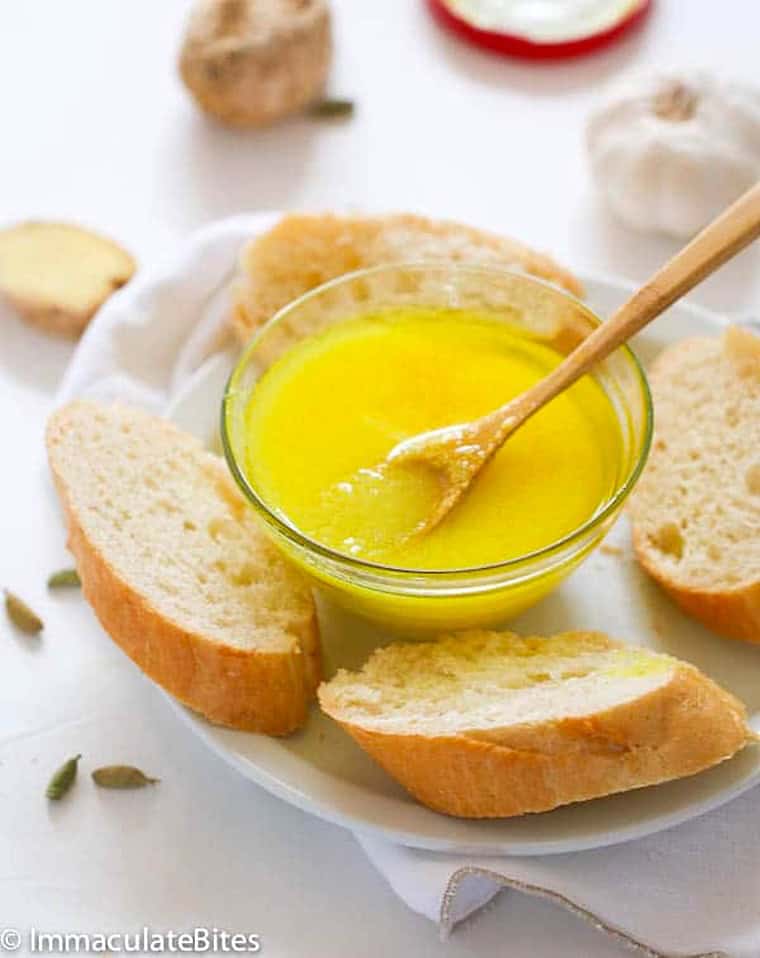
When I lived in LA, we had access to authentic Ethiopian cuisine. How I miss those restaurants! But fortunately, their recipes are a breeze to recreate at home. All it takes is a little patience, a saucepan, spices, and a cheesecloth (or a strainer to remove the leftover spices and milk solids).
Simply simmer melted butter, add the spices, and let it do its thing for about an hour. The ghee will turn a beautiful golden color with a nutty flavor. And since the butter has been clarified, you can use it at a higher heat, and it will last longer at room temperature.
Note: Clarified butter tastes and looks like butter. Ghee has to cook longer for a darker color and a delicious nutty flavor.
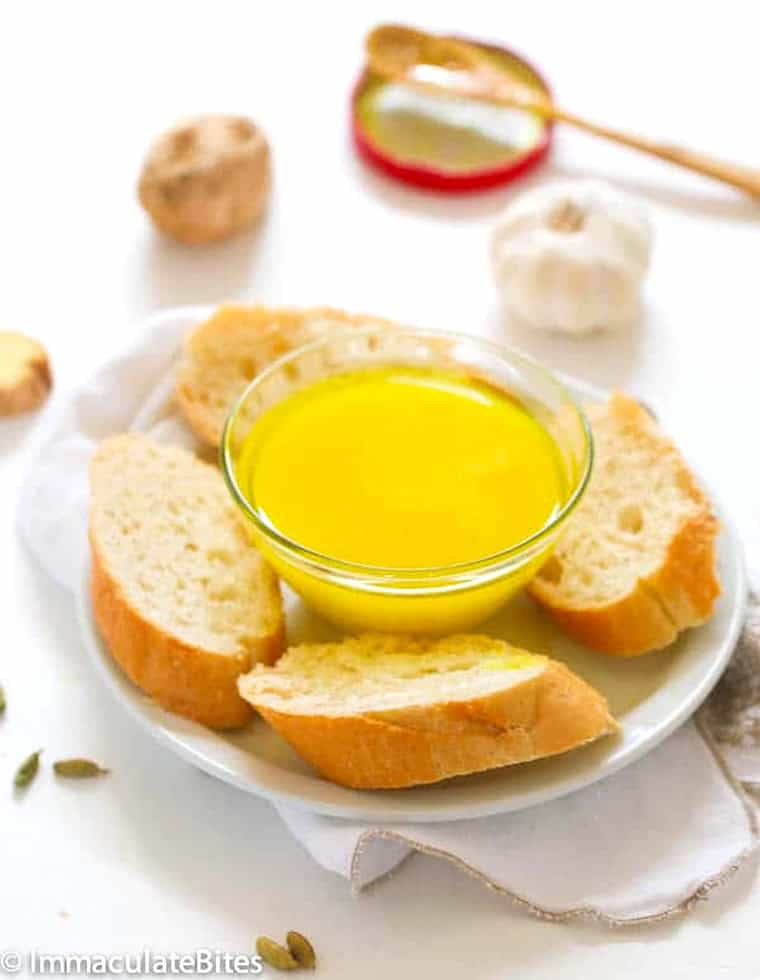
Why Spiced Ghee Works
First, fat is a great way to deliver aromatic flavor to rice, bread, and any stir-fry. Second, because the milk solids have been removed, you don’t have to worry about it burning as quickly or going bad. And third, if your friends have a dairy sensitivity (or are on a paleo diet), a lot of times they can enjoy the rich buttery flavor without suffering.
It’s also versatile. Switch out ingredients you don’t have and add what you do. When I read Marcus Samuelsson’s interpretation of this spiced butter, I jumped on it. The basil takes it over the top.
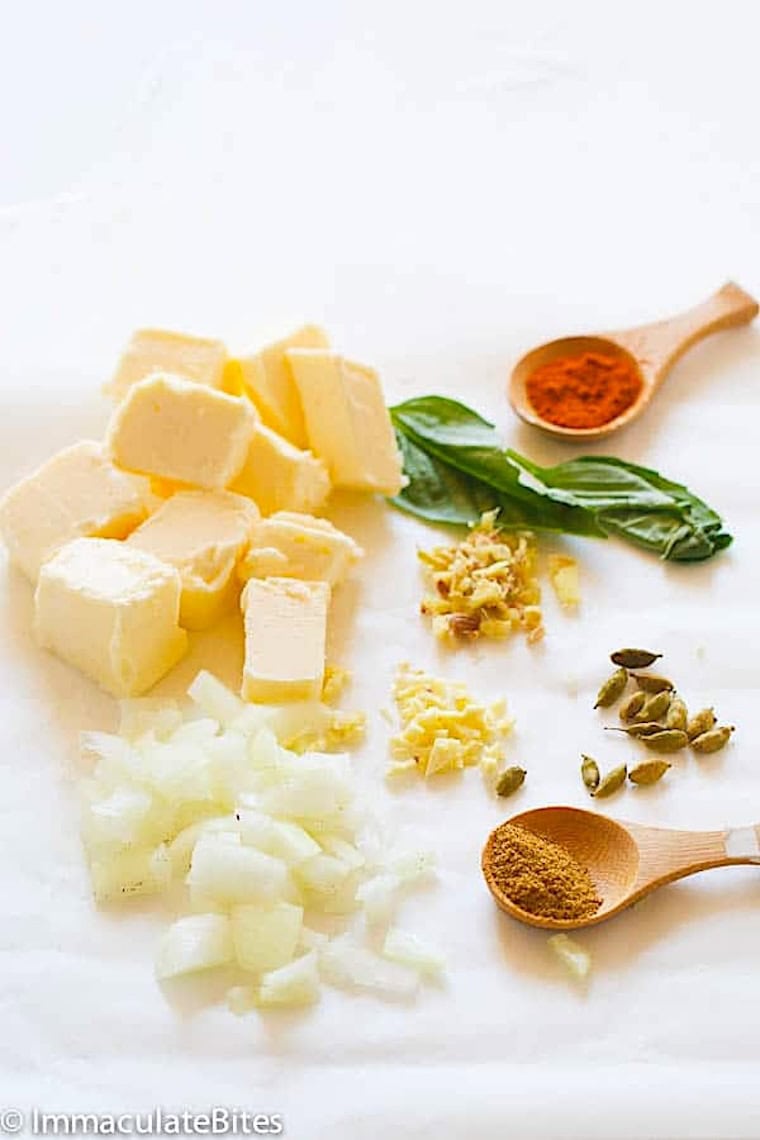
How to Make Niter Kibbeh
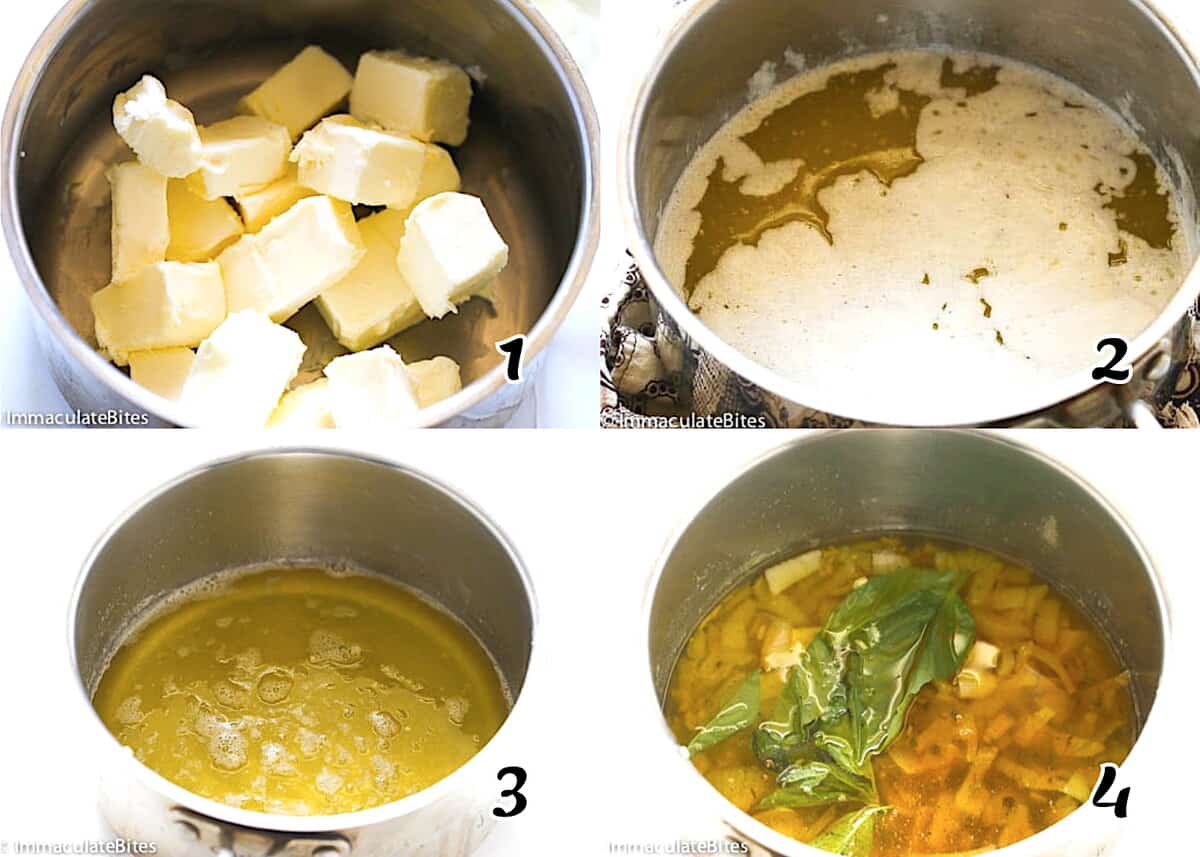
- Melt the butter in a medium saucepan on low heat. (Photo 1)
- Simmer without letting it brown until the surface is completely coated with foam. (Photo 2)
- Skim off the foam as it rises to the surface while cooking until nothing more remains. It should be transparent. (Photo 3)
- Add the onions, garlic, cardamom, fenugreek, cumin, ginger, nutmeg, oregano, turmeric, and basil. (Photo 4)
- Continue cooking on low heat for 15-20 minutes. The milk solids will toast on the bottom of the pan.
- Strain it through a cheesecloth or sieve. Use it immediately or store it in a tightly covered container.
Recipe Tips
- After stirring in the spices, don’t stir again until ready to strain.
- Strain while it’s still hot. It will solidify and look almost like butter when it cools.
Storage Instructions
A wide-mouth glass jar with a plastic lid is the best storage container. I absolutely love that ghee will last up to six months at room temperature and a year or more in the fridge.
How to Use Ethiopian Spiced Butter
My favorite is lentils, but it goes great in collard greens and cabbage. Hearty yataklete kilkil with potatoes doesn’t always have it, but it definitely won’t hurt. Sometimes, I slather it on a piece of toast for a happy dance.
More Awesome Spicy Sauce Recipes to Try
By Imma
This blog post was originally published in October 2015 and has been updated with additional tips and gorgeous photos.
Ethiopian Spiced Butter
Ingredients
- 1 pound (450g) unsalted butter
- 1 small onion, chopped
- 3 tablespoons (45g) minced garlic
- 1 teaspoon (2g) cardamom (see notes)
- 1 teaspoon (4g) fenugreek seeds
- 1 teaspoon (3g) ground cumin
- 1-2 tablespoons (15-30g) minced ginger
- ¼ teaspoon (1g) grated nutmeg
- 1 teaspoon (2g) dried oregano
- ½ teaspoon (1-2g) ground turmeric
- 5-6 basil leaves
Instructions
- Place butter in a medium saucepan and melt it completely on low heat.
- Simmer without letting it brown until the surface is completely coated with foam.
- Skim off the foam as it rises to the surface until no foam remains. It should be transparent.
- Add all spices: onions, garlic, cardamom, fenugreek, cumin, ginger, nutmeg, oregano, turmeric, and basil.
- Continue cooking on low heat for 15-20 minutes.
- Pass it through a cheesecloth or sieve. It's now ready to use. Store in a tightly covered glass container. It will last for 5-6 months at room temperature and up to a year in the fridge.
Tips & Notes:
- Cardamom pods have a unique flavor, a little different from the seeds. If you have whole pods, smash them, separate the seeds, and add both the pods and the seeds to the ghee.
- Some recipes call for a small stick of cinnamon and a couple of whole cloves. It’s very good.
- Don’t cover the saucepan while cooking the ghee so that excess moisture can escape.
- You can make it in a slow cooker on low for 8 hours for a set-it-and-forget-it version. It may look burnt, but as soon as you strain it, it will be beautiful and nutty.
- Please remember that the nutritional information is a rough estimate and can vary significantly based on the products used in the recipe.


This looks and sounds tasty, can’t wait to try it. I wondered about the leftovers (onion, garlic, basil leaves etc.), is there any way to use it? It could be added to a main dish like curry or stew, do you think?
Thanks! 🙂
You can definitely use the leftovers in some other dish :)! Thanks for stopping by Lyly.
I can’t seem to find fenugreek seeds, would the powder work?
Yes, you can replace the teaspoon whole fenugreek seeds with ½ teaspoon ground fenugreek. Since it is powder, you’ll need to use a finer mesh sieve or cheesecloth to strain it. Please let me know how it goes.
Can the fenugreek seeds be replaced with fenugreek power, if so, any different measurements?
Yes, you can replace the teaspoon of whole fenugreek seeds with ½ teaspoon of ground fenugreek. Since it is powder, you’ll need to use a finer mesh sieve or cheesecloth to strain it. Please let me know how it goes.
Thanks a million for your blog! I love african food. But never dared to do it myself. Yesterday I gave it a go for a vegan Valentines surprise with your blogs help. 🙂
The recipe above, berbere spice mix, injera, collard greens and the lentil stew are definite keepers!
Everything turned out beautifully!!
Best regards from Germany. xxx
Woohoo! Looks like you had a pretty great Valentine’s Day, Kirsten. Thank you for trying them all out. That means a lot to me.
Hi! Looking forward to getting this in my pantry but I can’t get fennugreek seeds anywhere. I have randomly been able to find fenugreek leaves. Can I use them as a substiture or should I leave it out altogether? Should I even bother without fenugreek seeds?
Yes, you can use the leaves because they also have that maple syrup vibe. But you could also use mustard seeds. I also like adding a little cinnamon if I’m out of another spice 🙂
Thank you for bringing this up to our attention. It might have gotten lost during our site update process. Anyway, please recheck the updated recipe box above and refer to the step-by-step photos with instructions just below the box.Thank you.
Hi,
I just found you’re website a few days ago while I was looking for a Niter Kibbeh recipe. I was super excited to make it! I love Ethiopian food. It’s my second favorite cuisine next to Louisiana cuisine. I’m totally bias, not just cause I am from Louisiana but we do have the best food. Sidenote: If you are ever in New York, Massawa located in Harlem has the best Ethiopian food in NYC. Anyhow, my Niter Kibbeh came out perfect!!!!! I told my sisters about it and I may end up making their Christmas gift. Thanks!!
I loooove Ethiopian food as well Iris! New York is also one of my favorite places so I’m so excited to try that out the next time I go. Thank you for the suggestion and of course for stopping by 🙂
Great Recipe! we live in the DC metro area, which also has the largest population of Ethiopian Americans in the US. There are a TON of good to excellent Ethiopian restaurants here. If you ever get a chance to check out Ethiopic, it is fantastic, in DC. Our favorite local place, about a mile away, is Meaza, right at the Falls Church/Arlington border, and we have been eating there for over 20 years.
Oh great to hear that. Thank you so much!
I absolutely love this. I made the African spiced butter too. To die for! I also drizzled in some honey with the greens . ☺️
Oops I meant to post this on the collard greens recipe. Still five stars. Loved the fenugreek here.
Hi Maryam. Glad you loved it. Thanks for stopping by!
Do you have any recommendation on how to store and how long you can store the niter kibbeh once it’s made?
Sorry! Just seeing the note about storing in the fridge for a month 🙂
Is the cardamom green or black?
I used green cardamom, but I’m sure the black would be just as tasty.
hey i love your blog! made doro wot (w/ tofu in lieu of chicken) last week but made it without the spiced butter. was still yumm, but i plan on making the niter kibbeh. wondering if the cardamom and fenugreek go in as whole pieces, crushed, or ground? since it doesn’t say i’m guessing whole. thank you!!
Thanks Mark! Whole or crushed is best, but ground will work in a pinch! Glad to hear the doro wot worked out well for you. Happy Cooking!!!
Hi All,
Does anyone know an online shop in the UK which sells Ethiopian products like Mitmita, Miten Shiro, Injera, etc…
Thanks in advance.
My favorite place is ethiopianspices.com – they ship worldwide (everything except fresh injera). They sell a huge variety of Ethiopian products. They’ve been in business in the US for over 15 years, and I’ve ordered from them several times. They are very nice, and you can call them on the phone.
Dear Imma,
Can you kindly post a niter recipe that uses korerima and koseret, which I luckily can buy from a local Ethiopian grocery nearby. I tried in vain to find a link for such niter recipe, which I used to go to, but that link is no more. Thank you.
Hi Katz. Feel free to add those ingredients to the recipe. That’s how versatile it is 🙂
I just saw ur recipe for the Ethiopian butter and I am quite amazed to the amount of ingredients it needs. There are two things that we put and it is Korerima and koseret ( sorry don’t know the English translation) And it still doesn’t compare to the butter from Ethiopia cause butter u find in US makes it taste creamy.
Using korerima and koseret – I would like this information also. Korerima is known is black cardamom. I read that koseret is: A relative of lemon verbena, this unusual herb is essential to making Niter Kibbeh, or Ethiopian spiced clarified butter (ghee). I became interested in Ethiopian cooking as a quarantine activity and would love to know how to use these spices in the butter or anything else. Thanks!
I haven’t because they’re too hard to find where I live in the States. However, the spices I use do their best to get close to the original ingredients. If you can get the black cardamom and koseret, add them at the same time as you would the other spices.
Here is a video recipe for traditional Ethiopian butter using the ingredients you mentioned! https://youtu.be/PNVlgaOiink
Hi Imma,
I was wondering. Could I use ghee as an already clarified butter and then just add the spices?
Thanks
PS Your website is awesome. I’m a student and a lot of the recipes make some really thrifty ingredients super delicious. I’ve made your Ethiopian lentil stew (using coconut oil) with injera. It has become my staple dinner between paydays (way better than instant ramen packets or cereal).
Hi Marcus! You sure can it won’t make that much of a difference.Thank you so much for taking the time to share your thoughts. Happy Cooking.
To sub for 1 pound of butter, how much Ghee would you use and would you just heat it to a certain point, then add the rest?
Hi Denise, one pound of butter makes about 12 ounces or 1½ cups of ghee. However, the measurements are flexible. Thanks
I regularly make clarified butter (ghee) from butter. You melt and simmer the butter until it completely separates into 3 layers. You skim off the top layer as you cook it and let the bottom layer stick to the pot (same as in this recipe). You then pour off the middle layer and that middle layer is your ghee. This recipe extracts the ghee from the butter using a similar process. I usually get a 2/3 to 3/4 yield of ghee from butter, so if using ghee for this recipe, I would use about 3/4 of the amount of ghee that is recommended for butter and your final product flavor should be very similar to this recipe.
Hello Imma. Thanks for posting these Ethiopian recipes. I have some bishop weed (ajwan) and black cumin (kalonji, black nigella). I bought them to use in Ethiopian dishes, but for the life of me can’t find the recipes that called for them. Do you suppose they would work in niter kibbeh?
Hi Richard! black cumin and ajwan would do just fine in this spiced butter. Have you tried adding it to Ethiopian lentil stew?
I haven’t had those in years. Ajawan is so good with any bean dish. And kolang reminds me of breakfasts. Sha zerra is teh real missing link here. As Hindu I would drop the basil & use Marjorim instead of butter. In oil a bit of spice goes a long way. I always throw a Thai pepper or Serrano or two. As a vegan Ethiopian restaurant food is my fave!
Thanks for sharing!!!
Can I use coconut oil instead of butter?
You sure can.